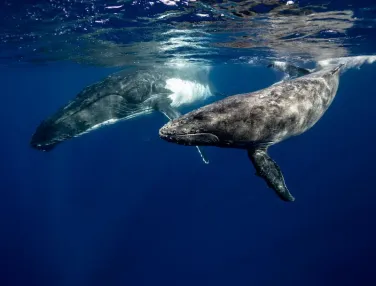
MONICET is a platform that brings together observations from whale watching companies as they go about their daily business of taking people to see those magnificent and intriguing creatures. While catering for a pleasant experience for their clients, skippers and guides note the species observed, count the animals, and record their position. They also take pictures of particular features of the animals, such as the fluke of a diving sperm whale. This information is uploaded to a dedicated online database.
The MONICET platform converts the raw data voluntarily provided by the participating companies into valuable information for the public, for the companies themselves and for scientists. On this site you can look at the patterns of species distribution, see how their numbers change in time, and (coming soon) investigate the movements of individual animals through photo-identification.
Cetaceans play a key role in the ocean environment. They are also highly intelligent animals, living in complex societies and exhibiting a wide range of behaviors.
The way of life of most cetaceans, however, is still largely unknown, mainly because they live in an environment so different from ours. Fortunately, there is a group of people lucky enough to spend a great deal of time near wild whales and dolphins: the staff of whale watching companies!
Realizing the social importance of the observations they make and of the knowledge they have accumulated, whale watching companies have joined hands with scientists and put together the MONICET platform, which has been running since 2009.
Committed to the highest standards of scientific collaboration and data sharing, MONICET data is freely available, subject only to the acknowledgment of the source. See the González García et al. (2023) paper for more details.
MONICET was created by a research group and three pioneer whale watching companies (Futurismo, Picos de Aventura and Terra Azul), with an initial grant from the Azores Government. It is run on a voluntary basis, its maintenance and development funded by donations and contracts. The latest round of development was funded by a grant from the LIFE IP AZORES NATURA project, in a joint management effort between OKEANOS Institute of Marine Sciences and the Ocean Azores Foundation.